 5.0
TL;DR
- An outside AV company may work at the center for services that are not exclusive, but only with approval from center management.
- Union stagehands do the hands on work. The outside company brings the gear and the plan and supervises; every IATSE call has a four hour minimum.
- House sound, rigging plan approval and internet belong to the center's own providers. Venue power gets connected only by the center's approved electrical contractor.
- The guide sets deadlines months out: insurance, labor, the rigging plot and the dock schedule. Start with your event manager, not with a gear list.
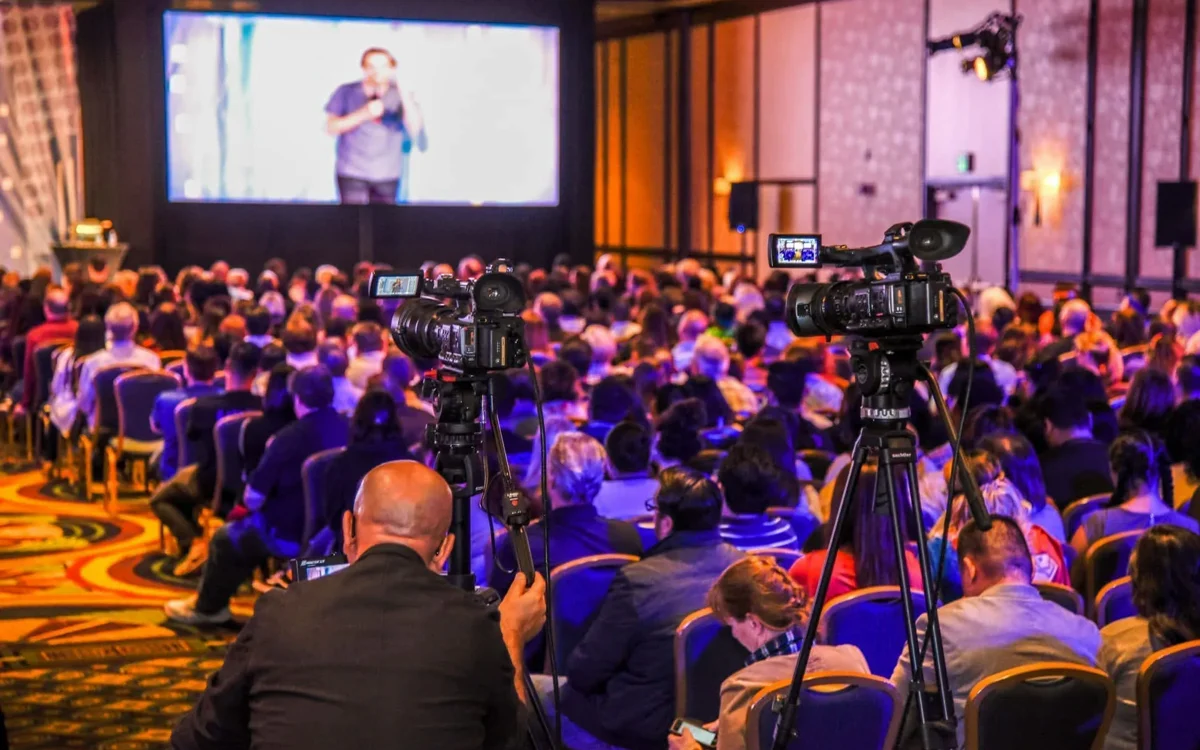
The Miami Beach Convention Center AV rules decide who can touch a cable, who hangs a truss and who gets paid for both. If you are a planner thinking about bringing your own production company into the building on Convention Center Drive, those rules shape your budget more than any speaker or screen you pick.
We should say up front where we stand. We are an outside team: a family owned production company from Miami that handles corporate events, conference sound, screens, staging and on site technicians. We hold no house, exclusive or preferred status at the convention center, and this post does not claim we have worked inside it. What follows is our reading of the center's own published pages, written so you can walk into your first call with the right questions.
Everything below is as of our last check of the center's Service Providers page, its FAQ and its 2026 Event Planning Guide on November 12, 2026. The guide says the center can change it at any time, so confirm every point with your assigned event manager before you sign anything.
Miami Beach Convention Center AV Rules at a Glance
Five ideas cover most of it. Learn these and the rest of the guide reads like detail.
- Outside AV is allowed, with approval.The Service Providers page says outside suppliers may operate in the center for certain non exclusive services with prior approval by center management.
- Union crews do the labor.The center is party to agreements with IATSE and IBEW. Staging, production and audio visual work is done by union labor anywhere in the building, and the outside contractor supervises.
- Some services stay in house.The house sound systems, approval of rigging plans, internet, catering and valet each run through a provider the center names.
- Paperwork runs on a calendar.The guide's event checklist starts twelve months out and ends thirty days out, with insurance, labor and rigging each on their own line.
- Your event manager is the door.Labor calls, approvals and schedule changes all route through the event manager the center assigns to your show.
Can an Outside AV Company Work at the Miami Beach Convention Center?
Yes, for services the center has not made exclusive, once center management approves it. The guide adds that a show manager's AV contractor may operate in the building with prior notification and must follow the center's contractor requirements.
The center lists an in house AV and rigging provider on its Service Providers page, and that company can quote the whole job. You are not choosing between that provider and nobody. You are choosing who designs and supplies the show, knowing that some pieces belong to the building no matter who you hire.
Two practical points follow. First, ask for the approval in writing, with your production company named, the rooms listed and the scope spelled out. Second, ask the in house provider for its own quote on the pieces it controls, so your budget has both halves before you compare anyone.
Which Services Are Exclusive or In House at the Convention Center?
The center splits its providers into exclusive, preferred and approved. As of our last check, these were the ones that matter most to a production team:
- House sound in halls, ballrooms and meeting rooms.Every meeting room has a built in sound system, and using it is the in house AV provider's exclusive right. The guide warns that labor to install, operate and tear down may apply when an outside contractor is involved. Commercial recording of a session carries an audio patch fee per room, billed by the in house provider.
- Rigging plan approval.The in house provider reviews and approves rigging plots and plans and is also the center's preferred rigging service. More on that below.
- Fixed digital signage.The building's own digital displays and their content run through the in house provider, with play ready content due at least thirty days before it goes live.
- Internet and telecom.Listed as exclusive to the center's network provider.
- Food and beverage, valet, police, fire watch and EMS.Not AV, but they share your load in hours and your floor plan, so they belong on your schedule.
If your show relies on sound systems or microphones and presentation audio in breakout rooms, ask early whether you will use the house system or bring your own, and what each choice adds in labor and patch fees.
How Does Union Labor Work for an Outside AV Team?
Your production company supervises, and IATSE Local 500 stagehands do the physical work. The center's FAQ answers "Can I hire my own AV labor?" by saying staging, production and audio visual work must be done by union labor under its agreements with IATSE and IBEW.
The guide is specific about scope. Local 500 handles entertainment, stage work and AV operations, and AV load in, setup, show, move out and load out are staffed by IATSE. It covers rigging in ballrooms and exhibit halls and reaches into exhibitor booths in the halls too. Florida is a right to work state, and the guide says so, but these agreements still apply inside this building.
The appendix on the Local 500 agreement lists the jobs you will see on a labor estimate: AV techs who set screens and LED walls, riggers who hang motors and truss, special equipment operators on switchers, audio boards and wireless coordination, camera operators and loaders at the truck. It also sets the terms that move a budget:
- Four hour minimums.Every call, whether move in, show or move out, is billed at four hours or more. A one hour strike still costs four.
- 48 hours notice.Calls go through the event manager or the technical manager with at least 48 hours notice, and repeat or longer calls are ordered by 2 PM the day before.
- Overtime triggers.Time and a half after eight hours, on Sundays and holidays and on Saturdays after 5 PM; double time after twelve hours and from midnight to 6 AM. Schedule load in to dodge them where you can.
- Loader counts by truck size.Two loaders for a trailer of 22 feet or less, four for anything longer.
- Payment before the show.The labor estimate is paid in full at least 14 days before the first contracted date, then settled after.
Outside supervision is allowed, the agreement says, as long as it does not displace working union stagehands. For our side, that means our job at a building like this is the design, the gear, the show file and a technician who knows every input, standing next to the crew that plugs it in. That is the same role our on site technical support plays anywhere, with a different set of hands on the cases.
Who Handles Rigging, Truss and Hanging Screens?
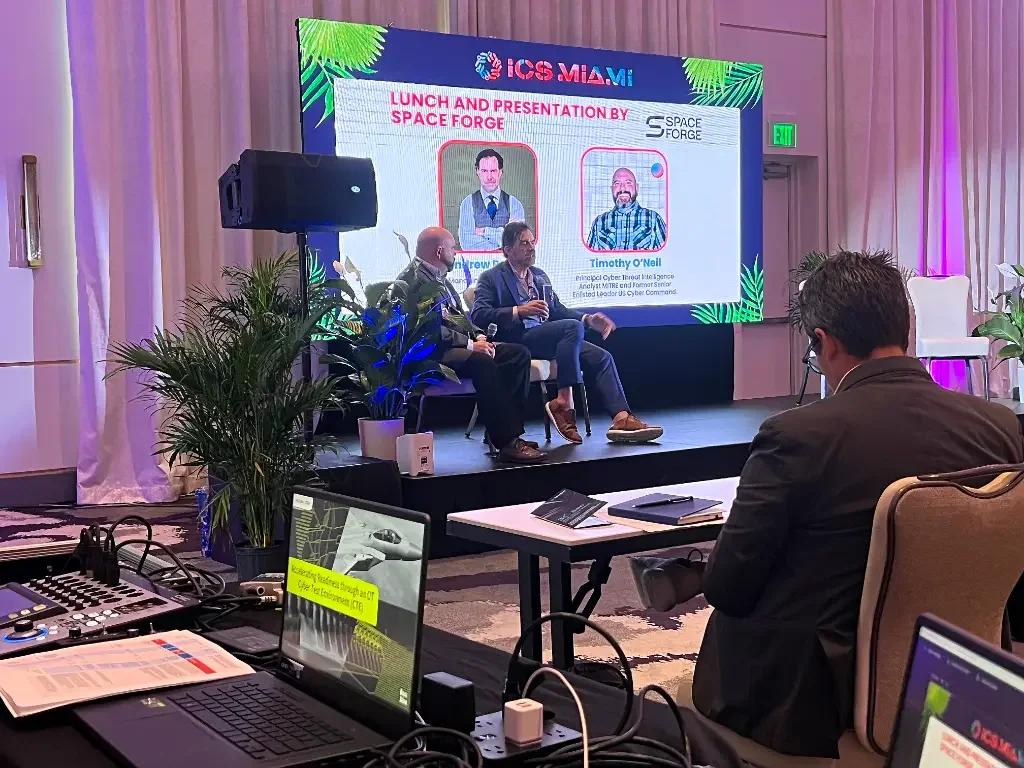
The in house provider reviews the plan, and union riggers hang it. As of our last check, the guide gives the in house provider the exclusive right to review and approve every load bearing rigging design in the building.
The labor appendix draws the line clearly: any rig using truss and motors, or any dead hang of 200 pounds or more, needs that review before the show starts, and the in house provider supplies a rigging supervisor for install, show and strike. Catwalk access needs a signed center waiver, and anything placed on a catwalk or the roof needs a stated purpose and details.
On the guide's checklist, the rigging discussion sits at two months out and the rigging plot is due at thirty days. If your design flies an LED wall, a projection screen or a lighting truss, get the drawing to your production company early enough that they can revise it once. Our LED video walls in Miami Beach and trussing pages explain the gear side; ground supported walls and stages avoid the flying question but still go on the floor plan.
What Are the Power and Internet Rules?
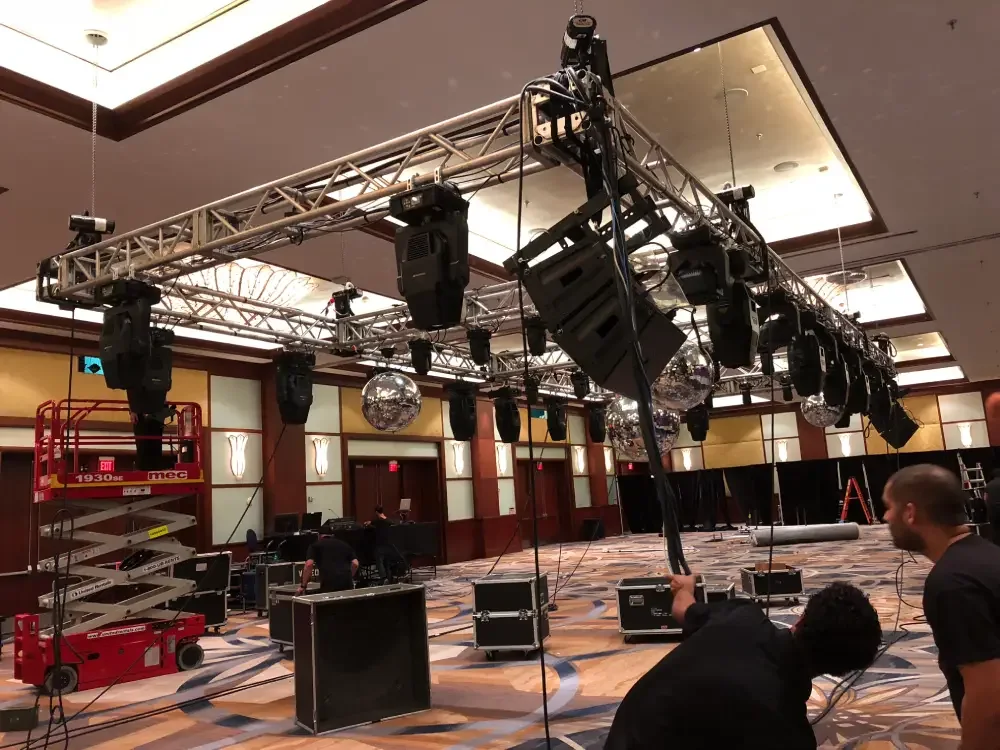
Bring your own distribution if it meets code, but let the center's approved electrician make the venue connection. The guide prohibits anyone except the approved, licensed and insured electrical contractor from connecting to or disconnecting from the building's power. Temporary gear must be UL listed and meet local and national codes, with 14 gauge wire or heavier on every connection.
Halls and ballrooms have utility floor ports about every thirty feet. Cables crossing any floor get taped with hazard tape or run under covers, and the guide bans cable runs across doorways, under doors, under airwalls or through mouse holes. Plan cable paths on the floor plan, not on the morning of load in.
Internet is simpler to describe and harder to work around: the guide lists one exclusive provider, and the halls, meeting rooms and ballrooms are wired with CAT6 and fiber. The FAQ notes free WiFi in lobby areas only. If your show streams, uses remote presenters or pulls content from the cloud, order a wired line with the bandwidth written down, and tell your camera and video mixing team what they will plug into.
What Do Drape, Haze and Fire Rules Require?
Every fabric needs to be flame resistant, and every effect needs a permit with lead time. The fire section of the guide requires drapes, curtains and similar fabrics to pass NFPA 701, scenery and sets to be treated fire retardant, and documentation available on request. Styrofoam is not allowed for set construction.
- Drape.Ask your provider for the flame certificate for the exact fabric going up, and keep a copy at the show office. Our pipe and drape page covers backdrops and room dividers on the island.
- Haze and fog.Allowed with a Miami Beach Fire Department haze permit and notice to the event manager at least 21 days ahead, including rehearsal and show times. Cleanup of any residue is billed.
- Fire watch.Required, among other cases, whenever a smoke or fire sensor has to be disabled for AV, rigging or haze, and for permitted cold spark or flame effects.
- Lasers.Need a fire department laser permit and state registration, with beam paths drawn out.
For exhibit halls, floor plans go to the event manager at least six months before the first move in day for Fire Department approval, so the stage, screens and tech positions need a place on that plan early.
How Do the Loading Docks, Freight and Badges Work?
On your schedule, not the truck driver's. The guide asks the licensee for a detailed move in and move out schedule, including freight deliveries, and says the center may change it to fit other events in the building. Gate security runs the docks, and the general service contractor schedules the semi trailers.
- Two docks.The North Loading Dock, entered at 2000 Convention Center Drive, is shared between semis and private vehicles, with no idling past five minutes. The South Loading Dock is entered from Convention Center Drive and 18th Street. The center keeps no marshalling yard of its own and lists suggested sites off the island.
- No deliveries to the building.The center does not accept freight or packages. Shipments go to your general service contractor.
- Labor entrance and badges.Workers use the labor entrance at Washington Avenue and 18th Street, and everyone working in the building wears an approved show credential, ESCA badge or center photo badge.
- Freight elevators and floors.Freight elevators carry freight only, and meeting room carpet gets covered in visqueen before move in. Pallet jacks need floor protection and scissor lift tires get wrapped. Loading at the main guest entrances is not allowed.
- Hall lights.Work lights at half brightness are free during move in and out; full show lights come on two hours before show time.
For a crew coming over the causeway from the mainland, that means a dock time, a badge list and a truck length sent ahead, so the right number of loaders is waiting. Our Miami Beach page covers the drive, the bridges and the hotels around the center.
What Insurance Certificates Does the Center Ask For?
The guide puts insurance on the licensee, which is usually the show organizer, and asks for proof before anyone occupies the space. As of our last check, policies must name the City of Miami Beach and OVG as additional insured, and the original certificate is due thirty days before the lease period starts. The checklist in the back puts "Certificate of Insurance Due" at three months out, so plan for the earlier date.
The guide lists the required coverage limits. It also says that when exhibitors use independent contractors, the center verifies their insurance to the same limits, and that a certificate issued by an agent outside Florida must be countersigned by a Florida resident agent. Ask every vendor on your show, including your production company, how fast they can issue a certificate with that exact wording, and send the wording to them in writing.
What Should You Ask Early, and When?
Ask in the order the guide's own checklist runs. These are the questions we would want answered before we quote a show in this building:
- Twelve months out.Which services are exclusive for our dates? Is our production company approved for the scope we want, in writing? Can we tour the rooms with them?
- Six months out.Where do the stage, screens, front of house and camera risers sit on the floor plan going to the Fire Marshal?
- Three months out.Is the certificate of insurance filed? Have we started the AV contractor and IATSE conversation with the event manager?
- Two months out.Has the rigging discussion happened, and does the plot need motors or any hang over 200 pounds?
- Thirty days out.Are the dock schedule, the AV and IATSE labor schedule and the rigging plot final? Is the labor estimate paid by the deadline?
How much AV costs at a convention center depends less on the gear than on the hours: labor minimums, overtime windows, house sound and patch fees, power orders and internet. A quote that lists equipment alone is half a quote. Our post on how to choose an event production company in Miami covers what else to compare.
Not every show lands on the convention center floor. Many groups in town for a big show hold breakouts, investor dinners and receptions in hotel ballrooms nearby, and those hotels write their own vendor rules. Ask each one separately; the center's guide does not cover them.
Quick Answers
Can I bring my own AV company to the Miami Beach Convention Center?
For services that are not exclusive, yes, with prior approval from center management, as of our last check. Union stagehands still do the hands on work, and your company supervises. Confirm the scope in writing with your event manager.
Is the Miami Beach Convention Center a union building?
Its published pages say staging, production and AV work is done by union labor under its agreements with IATSE and IBEW, and IATSE calls carry a four hour minimum.
Can an exhibitor set up their own booth LED wall?
The center's union agreement reaches into exhibitor booths in the halls, and the guide sends questions about what exhibitors may do in their own space to the technical operations manager. Check the exhibitor kit for your show too.
Who approves rigging at the convention center?
The center's in house AV provider reviews and approves load bearing rigging designs, including truss and motor rigs and dead hangs of 200 pounds or more, as of our last check.
Does SoFlo have house status at the convention center?
No. We are an outside production team with no house, exclusive or preferred status there. Tell us your show and rooms and we will work through the center's process with your event manager.