
 5.0
In Short
- Wall width is panel width times columns; wall height is panel height times rows; the panel count is columns times rows.
- A wall built from square panels is rarely exactly 16:9, so the drawing shows where your slides or video leave panels empty.
- The seating range uses a general screen rule based on content height. Pixel pitch also sets how close people can sit, and we confirm that per job.
- Send us the brief and we turn it into a real plan for your room, with no price shown here.
This LED wall size calculator answers the first question every host asks us about a video wall: how big will it actually be? LED walls are built from rigid panels, so the wall only comes in whole steps of one panel. Set the panel size, the number of columns and rows, and the shape of the content you plan to play, and the tool gives you the finished size in feet and meters, the panel count, and a scaled drawing of how the picture sits on the panels.
We are a family owned production company based in Miami, and our crews build LED walls for ballrooms, stages and outdoor shows across South Florida and Orlando. We built this so you can show up to a planning call knowing the numbers, not guessing at them.
How Does This LED Wall Size Calculator Work?
The math is simple multiplication, done for you in both feet and meters:
- Width and heightWall width in millimeters equals panel width times the number of columns. Wall height equals panel height times the number of rows. We divide by 1000 for meters and multiply meters by 3.281 for feet.
- Panel countColumns times rows. Twelve columns of seven rows is 84 panels. Every panel is a real piece of gear that has to be carried, built and powered, so the count matters for load in time.
- Wall shapeWidth divided by height, shown as a number to 1. A result of 1.78 to 1 matches 16:9 video; 1.33 to 1 matches 4:3 slides.
- Content fitYour content keeps its own shape and grows until it touches the wall on two sides. If the wall is wider than the content, panels stay empty on the left and right. If it is taller, they stay empty on the top and bottom. The tool reports the content size, the share of the wall it fills, and the size of the empty bands.
- Closest gridKeeping your columns, the tool tries the row counts on either side of a perfect match and suggests the one that leaves the least empty area. Press the button to try it.
A Worked Example: Twelve by Seven Panels
The concert or festival preset makes a good example, a wall around 20 by 11 feet: 500 by 500 mm panels, 12 columns, 7 rows.
- Size: 12 times 500 mm is 6.00 m, about 19.7 feet wide. 7 times 500 mm is 3.50 m, about 11.5 feet high.
- Panels: 12 times 7 is 84.
- Shape: 6.00 divided by 3.50 is 1.71 to 1, a touch taller than 16:9.
- 16:9 video: it fills the full 19.7 foot width and stands about 11.1 feet tall, leaving a band roughly 2.5 inches high empty at the top and at the bottom. The content covers about 96 percent of the wall. Nobody in the room will notice that band, and a content designer can fill it with a background color.
- Seating: with content about 11.1 feet tall, the first row sits about 22 feet back, slide text stays readable to about 66 feet, and video and big graphics carry to about 89 feet.
Now switch the content shape to 4:3 on the same wall. The slides now fill the height and stand about 15.3 feet wide, leaving roughly 2.2 feet of empty panels on each side, so the content covers about 78 percent of the wall. That is the moment most hosts ask us to either redesign the deck at 16:9 or put a logo or speaker name in the side areas. If you want a wall that is exactly 16:9 with 500 mm panels, the grid has to be 16 by 9: 144 panels, about 26.2 by 14.8 feet. Plenty of ballrooms cannot fit that under the ceiling once the stage is in, which is why a near match is often the practical choice.
Which Content Shape Should You Design For?
Design for the wall you are getting, not for a laptop screen. Once your production company confirms the grid, ask for the wall's exact pixel canvas and build the slides and videos to it. Until then, these are the four shapes in the tool and when each one shows up:
- 16:9: what almost every camera, video file and modern slide template uses. If you have no reason to pick another shape, use this one.
- 4:3: older decks and some speaker templates. On a wide wall it leaves empty columns on each side.
- 1:1: square social clips and logo loops. On most walls a square fills only the middle, so it suits a sponsor moment more than a keynote.
- 32:9: an ultrawide backdrop made for long, low stage walls at concerts and festivals. On a standard ballroom wall it looks like a thin strip.
Never stretch a picture to fill the panels. Faces, logos and circles distort, and audiences spot it in seconds. Letterboxing (empty bands top and bottom) or pillarboxing (empty bands left and right) keeps the picture honest, and the empty panels can carry a color, a pattern or event branding.
How Far Back Should the First Row Sit?
The seating range in the tool uses a general rule of thumb from screen planning, based on the height of the content, not the whole wall:
- First row: about two times the content height. Closer than that and people turn their heads to follow the picture.
- Farthest seat that can read slide text: about six times the content height.
- Farthest seat for video and large graphics: about eight times the content height.
This is a planning rule, not a promise for any room. A second limit comes from pixel pitch, the spacing between the lights on each panel: the tighter the pitch, the closer people can sit before they see dots. The tool does not ask for pitch because we do not want you planning around a number that may not match the panels on your date. We confirm the pitch for your room, and if your front row is close we tell you.
What Does the Calculator Not Model?
It sizes the face of the wall and nothing behind it. These all change the final plan and are worth a conversation:
- Pixel pitch, resolution, brightness and which panels are actually free on your date.
- Ceiling height, sprinklers and the clearance a hung wall needs, or the footprint and ballast a ground supported wall needs.
- Weight, power and how far the nearest circuits are.
- Sightlines from the sides and back, around a lectern, a band or a camera riser.
- Outdoor sun, wind and rain, which change the panels and the structure. Our post on outdoor LED walls in Florida weather and sun covers what to plan for.
- Curved walls, staggered sections, side screens and split layouts.
- Cameras, live feeds and how the picture reaches the wall.
- Cost. Nothing here prices a wall. Our guide to what drives the cost of an LED video wall rental explains what does.
When Should You Call Us Instead?
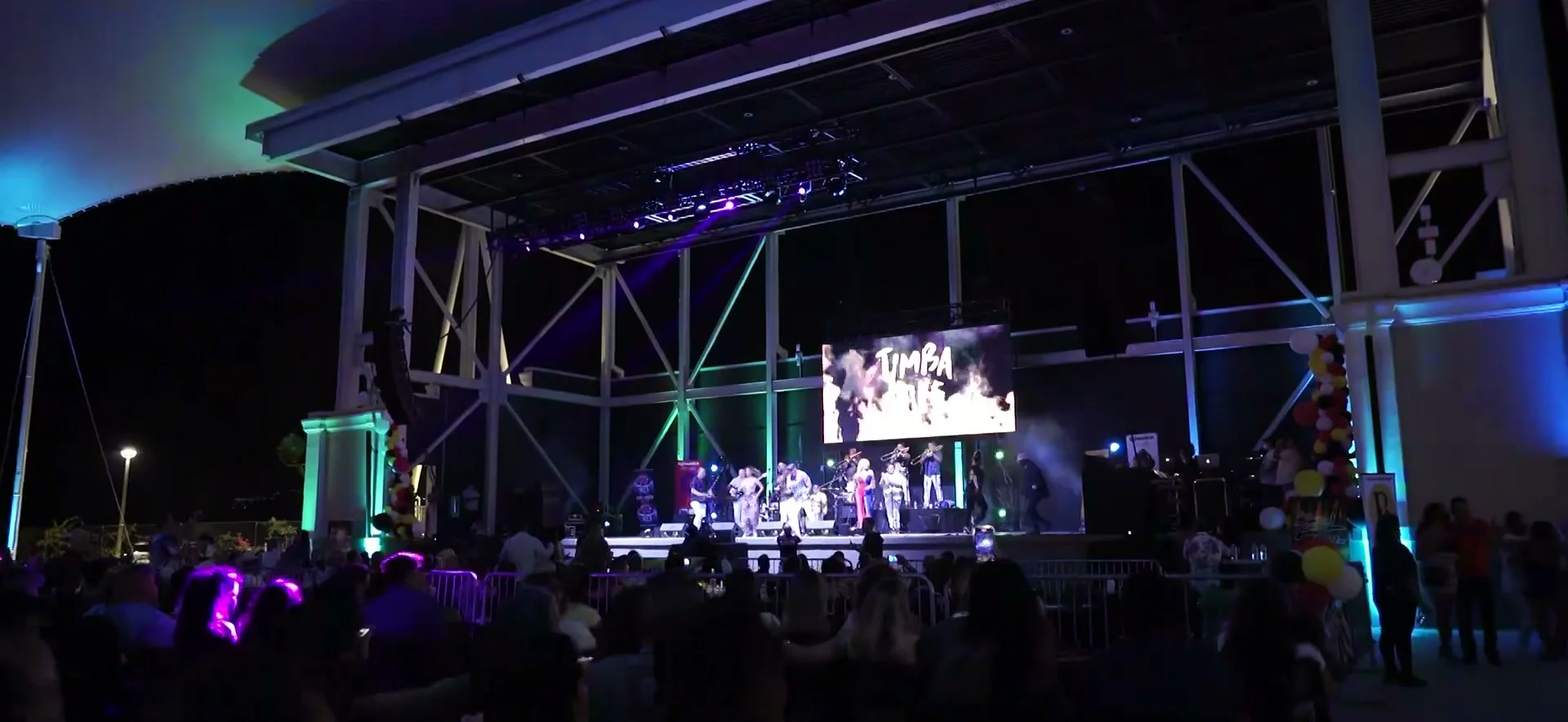
Use the tool to get a starting size, then call or send the brief when any of these apply: the wall goes outdoors or near a pool in daylight; it has to hang from a ceiling or truss; the room has low ceilings or columns; you plan to show a live camera feed on it; you need two or more screens; or the event is a festival stage, like the amphitheater show below where we ran the lighting, audio and video.
Not sure an LED wall is right at all? Try the LED wall or projector quiz, read our comparison of an LED video wall or projector for an Orlando corporate event, or browse every planner on our tools page.
Everything about how we build walls is on our LED video walls service page, and each city has its own page for local venues and load in: Miami, Miami Beach, Fort Lauderdale, Hialeah, Boca Raton, West Palm Beach and Orlando. For screens that suit a smaller room, see projectors and screens.
Quick Answers
How do I calculate LED wall size?
Multiply the panel width by the number of columns for the wall width, and the panel height by the number of rows for the wall height. With 500 mm panels, 12 columns and 7 rows give 6.00 by 3.50 meters, about 19.7 by 11.5 feet.
How many LED panels do I need for a 16:9 wall?
With square panels, an exact 16:9 wall needs columns and rows in a 16 to 9 ratio, such as 16 by 9 (144 panels). Smaller grids like 12 by 7 or 8 by 5 come close and leave a thin unused band. Pick your columns in the tool and it suggests the closest row count.
What are the standard sizes of LED wall panels?
There is no single standard. 500 by 500 mm is common for event panels, and 500 by 1000 mm is another frequent size. Your production company's panels set the steps your wall can grow in, so ask for their exact panel size before you lock a layout.
What is the typical size of an LED wall for a wedding or event?
There is no typical size that fits every room. The wall has to fit under the ceiling with the stage, leave the sightlines open and be big enough for the farthest guest to read. Tell us the room and the guest count and we size it to that.
How far should the audience sit from an LED wall?
As a general rule, the first row sits about two times the content height back, and slide text stays readable to about six times the content height. Pixel pitch sets its own minimum distance, which we confirm for your room.
Why does the calculator not ask for pixel pitch?
Pitch depends on the panels actually available for your date and venue. We would rather confirm it with you than let the tool imply a number we have not checked.
What happens if my slides are 4:3 and the wall is wide?
The slides keep their shape and leave empty panels on both sides. You can rebuild the deck at 16:9 or ask your content designer to fill the side areas with branding or speaker names.
Is this calculator a quote?
No. It is a planning estimate. Send us the brief with your date and venue and we reply with a real plan and a quote.