
 5.0
The Short Answer
- Count lights by the walls you want lit, not by the guest list or the floor area.
- Each wall gets its length divided by your spacing, rounded up to a whole light.
- All four walls of a 60 by 40 foot room at 10 feet apart comes to 20 uplights.
- Doors, columns, drapes, ceiling height and wall color can move the real number, so we confirm it against your venue.
This uplighting calculator answers the first question couples and planners ask us about room color: how many lights it takes. It gives you a starting number in under a minute and a drawing you can show a venue coordinator, a partner or us. We place, color and pick up wireless LED uplights for weddings, galas and parties, and the count is always the first line of that conversation.
How the Uplighting Calculator Works
The math is short. For every wall you tick, the calculator takes the wall length in feet, divides it by the spacing you chose, and rounds the result up to the next whole light. Then it adds the walls together. The top and bottom walls use the room length; the left and right walls use the width.
Rounding happens wall by wall on purpose. A 45 foot wall at 10 feet apart needs 5 lights, not 4.5, because nobody rents half a fixture and a short gap at one end of a wall is easy to spot. Rounding each wall up keeps the gaps on every wall at or under the spacing you picked.
In the drawing, each light sits at the center of an equal slice of its wall, so the corners are never crowded and the spacing reads evenly. Change any slider and the count, the drawing and your planning brief update together.
A Worked Example: A 60 by 40 Foot Ballroom
Take a reception room 60 feet long and 40 feet wide, which is a common size for a hotel or banquet hall ballroom with around 150 seated guests.
- All four walls, 10 feet apart: 60 divided by 10 is 6, twice for the two long walls, and 40 divided by 10 is 4, twice for the short walls. 6 plus 6 plus 4 plus 4 is 20 uplights.
- All four walls, 12 feet apart: the long walls need 5 each, and 40 divided by 12 is 3.3, which rounds up to 4 for each short wall. That is 18.
- Only the two long walls, 8 feet apart: 60 divided by 8 is 7.5, rounded up to 8 per wall, for 16 lights. This is the plan when one short wall is all windows and the other is the kitchen doors.
- Only the wall behind the head table, 5 feet apart: 40 divided by 5 is 8 lights packed close for a strong band of color where the photos happen.
Same room, four honest answers between 8 and 20. That spread is why we ask which walls matter before we ask about color.
How Far Apart Should Uplights Be?
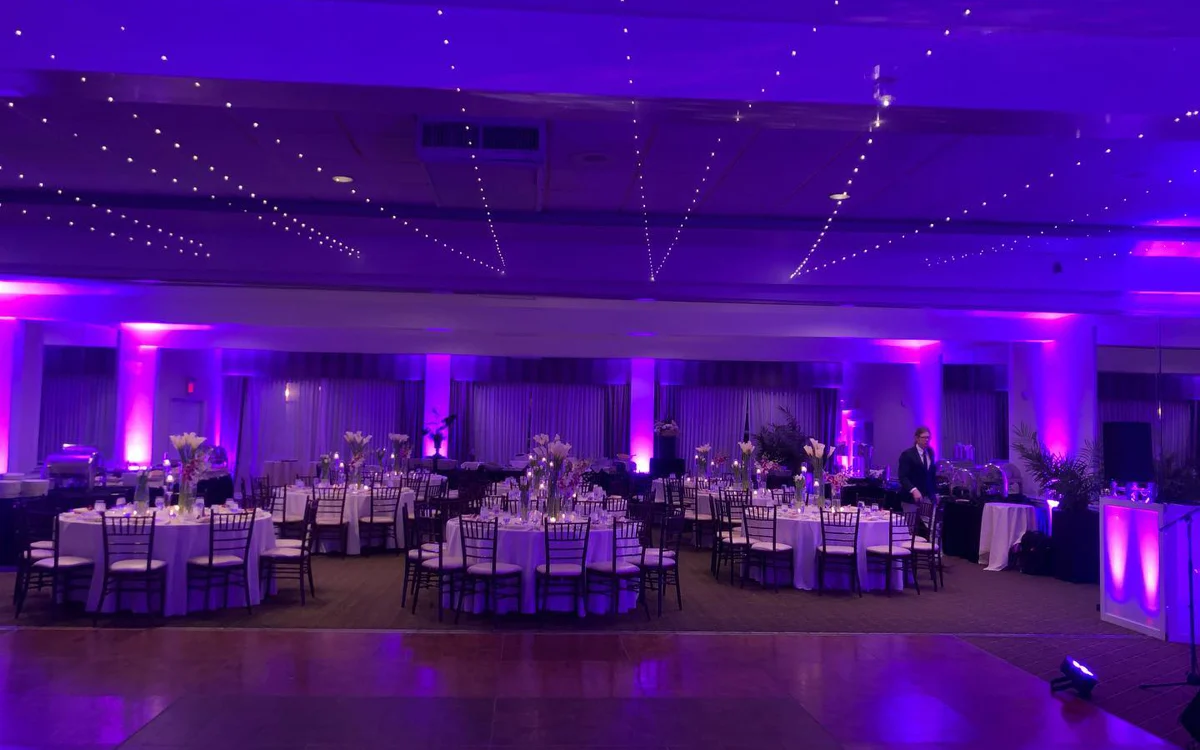
Most event lighting guides land between about 6 and 12 feet, with 8 to 10 feet the usual middle for a smooth wash. Closer spacing, 5 or 6 feet, gives a deeper, more continuous band of color. Wider spacing, 12 feet and up, leaves visible pools of light with darker wall between them, which can look intentional on columns or tall drapes.
The slider runs from 5 to 20 feet so you can see both ends of that range. Treat it as an illustrative planning range. The spacing that works in a real room depends on the light itself, how far it sits from the wall, how tall the wall is and what the surface is made of, and we set the final spacing when we see the venue.
What the Calculator Does Not Model
A rectangle with four walls is a useful sketch and a poor description of most rooms. Here is what the tool leaves out, and how each one changes the count.
- Doors, windows, mirrors and service entrances. Light on glass mostly disappears, and nobody lights a kitchen door. Subtract those stretches from a wall in your head, or untick that wall.
- Columns and pillars. A column usually gets its own light, and a wide or round one may want two. Add them on top of the wall count.
- Draping. Fabric takes color well, but heavy pleats and dark drape soak light up and may need tighter spacing.
- Ceiling height. A tall ballroom wall needs light that reaches higher before it fades, which can mean closer spacing.
- Wall color and finish. Pale, matte walls show color best. Dark wood paneling, wallpaper and glossy stone change how a color reads.
- House lights. Chandeliers left bright wash out uplighting. Ask the venue whether the room lights can dim.
- Odd shapes, tents and outdoor sites. L shaped rooms, clear tents, palm trees and garden walls do not fit a four wall drawing. Send us photos instead.
Which Walls Are Worth Lighting?
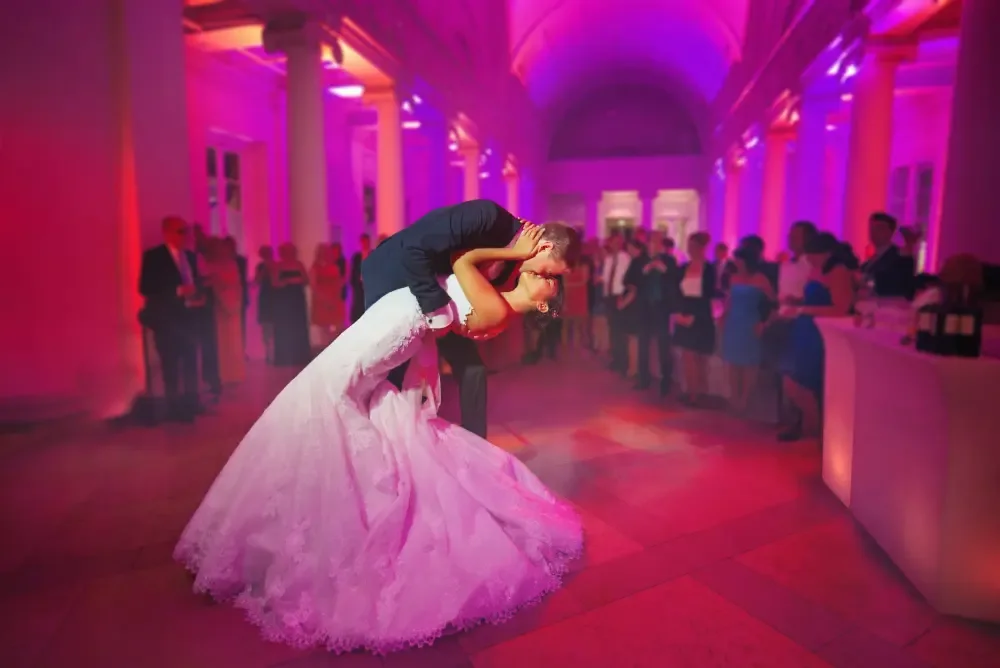
If the budget only stretches to part of the room, light what the guests and the camera face. The wall behind the head table or sweetheart table shows up in nearly every reception photo. The wall behind the DJ and the dance floor carries the party. The entrance sets the first impression. A long side wall with windows can often stay dark without anyone noticing.
Uplighting makes the biggest change in plain rooms: a beige ballroom, a bare banquet hall, a white tent. A room with dark wood, heavy art and its own sconces changes less, and fewer lights in the right places can do more there than a full ring.
Choosing the Color
The preview colors are violet, warm amber, warm white, ice blue, pink and green, and the brief writes the color out in words so nobody has to guess from a swatch. Warm amber and warm white flatter skin and wood; violet, blue and pink read as party colors; green suits a garden or a brand. For a corporate event we can match company colors, and for a wedding you can send a photo of the invitation or the flowers. Tell us the shade and we set it on site and name back what we set.
When to Call Us Instead
The tool is built for one rectangular room. Call or write to us instead when the room is an unusual shape, when the event moves between spaces such as a ceremony lawn and a ballroom, when you want the colors to change during the night, or when the venue has rules about outside lighting and power. Ask us too about a lighting technician who can run the room live with the DJ.
Bring three things and we can turn this estimate into a real plan: the venue name, the room you are in, and which walls you want lit. Use Add this plan to my quote above, or read more on our uplighting rental page.
Uplighting Across Our Area
We bring uplighting to rooms from the Miami waterfront to Palm Beach County and Orlando. Each city page covers its own venue types, load in and timing:
- Uplighting in Miami
- Uplighting in Miami Beach
- Uplighting in Hialeah
- Uplighting in Fort Lauderdale
- Uplighting in Boca Raton
- Uplighting in West Palm Beach
- Uplighting in Orlando
For bistro strings and how they pair with wall color, read uplighting and bistro lighting for South Florida weddings. For the whole room, including monograms and dance floor effects, see event lighting design. More tools live on our planning tools page, including the LED wall size calculator and the wedding DJ hours planner.
Uplighting Calculator Questions
How many uplights do I need for a wedding reception?
Measure the walls you want lit, divide each by your spacing and round up. For a 60 by 40 foot room with all four walls at 10 feet apart, that is 20. Lighting only the head table wall can take as few as 8. The calculator above does the math for your room.
Can I go by guest count instead of room size?
Guest count is a rough shortcut some charts use, but two rooms that seat 150 can have very different walls. The wall length you want lit is a far better guide, which is why this tool asks for the room, not the guest list.
How far from the wall does an uplight sit?
Close to the base of the wall, aimed up, so the color climbs the surface. The exact distance depends on the light and the wall height, and our crew sets it when we place the lights.
Do columns count as part of the wall?
No. Count columns separately and add them to the total. Most take one light; a wide or round column may need two to wrap it.
Will there be cords running across the floor?
Our uplighting is wireless LED, so the lights do not need a cord running along the wall or across a doorway.
Is the number from the calculator my quote?
No. It is a planning estimate, not a quote and not a final specification. We confirm the count, the placement and the venue rules before anything is booked. Send the plan with the quote form and we reply with both.
Can I use this to plan uplighting I set up myself?
The arithmetic works for any rectangular room. Keep in mind that the right spacing depends on the brightness and spread of the lights you actually use.
Does it work for outdoor events or tents?
Only loosely. Palm trees, garden walls and tent sides do not form four neat walls. Send us photos and the site plan, and we count from those instead.