TL;DR
- Uplights sit on the floor and paint walls, columns, drape and trees with color. Bistro lights hang overhead and give guests warm light to eat and dance by.
- Indoors, uplighting usually does the heavy lifting. Outdoors after sunset, bistro strands come first, because guests need to see their plates.
- Pick colors by name, such as amber, warm white or blush pink. Nobody should have to tell two swatches apart.
- Strands need something solid at every corner: tent frame, truss, poles or a structure the owner approves. Trees and palms work only when the venue allows it.
- On a beachfront property, decorative lights visible from the sand are off limits from March 1 to October 31 in Broward, as of our last check.
Couples ask us about wedding uplighting and bistro lighting in the same breath, and they are right to: the two do very different jobs, and most South Florida receptions that move between indoors and outdoors end up using both. This guide is about how they work together, room by room.
We are a family owned production company based in Miami, and lighting is part of nearly every reception we run. If you want the full menu of what we place in a room, our LED uplighting and event lighting design pages cover the gear. Here we go into the decisions behind it.
What Do Uplighting and Bistro Lighting Each Do to a Room?
Uplighting changes the color of the surfaces around your guests; bistro lighting changes the light falling on them. That is the whole difference, and every other choice follows from it.
An uplight is a small fixture set at the foot of a wall, a column, a panel of drape or a tree trunk, aimed up. It throws a tall fan of color that makes a plain ballroom feel finished and makes a dark garden feel like a room. It does very little for the tables: a guest in the middle of the floor is lit by whatever the venue already has.
Bistro lights, also called string lights or cafe lights, are strands of round warm bulbs hung across a space at head height and above. They become the ceiling. Under them, faces, food and the cake read clearly, and the photographer gets a soft glow in the background of every frame. What they do not do is color anything; the walls beyond them stay dark.
Do You Need Uplighting, Bistro Lights or Both?
Book uplighting when the room has walls worth coloring, bistro lights when the sky is the ceiling, and both when the night crosses from one to the other. A few common South Florida setups:
- Hotel ballroom, all night indoorsUplighting alone usually carries it. Add pin spots for the centerpieces and lighting on the dance floor through our stage and dance floor lighting work, and the room is done. Bistro strands indoors are a style choice, not a need.
- Garden, lawn or backyard after darkBistro lights first. Without them, guests eat by candle and phone screen. Then add a handful of uplights on the trees, the hedge or the back of the house so the edges of the party do not fall into black.
- Ceremony outside, reception in a tent or on a terraceBoth. Strands over the tables and the dance floor, uplights on the tent legs, the walls of the house or the palms around the lawn.
- Cocktail hour on a patio, dinner in a hallBistro lights on the patio where people stand and talk, uplighting inside where they sit. We plan the two together so the color of the bulbs and the color on the walls agree.
 Google review
“Edward and his team did an amazing job making our day special. Even two months later we are still receiving complements about the bistro lights and up-lighting that set the tone for the whole night. He really took our vision and made it a reality without breaking our budget - something we thought would be impossible! SoFlo Main events went above and beyond to make sure everything from the ceremony AV to DJ to the photo booth were absolutely perfect. I would highly recommend them to any bride and groom to be.”
Which Wedding Uplighting Colors Work, Described in Words?
Amber and warm white flatter skin and photograph well almost anywhere; saturated colors look dramatic in person and need more care on camera. Name the color you want in words and we set it. We never ask anyone to choose between two swatches, which matters for the many guests and couples who see color differently.
- Amber or candlelight. The safe default. It warms white walls, wood and stone, and it sits well next to warm white bistro bulbs, so the inside and outside of the night match.
- Warm white. Not the same as amber; it reads cleaner and brighter. Good on cream drape and in rooms with a lot of architecture you want to show off as it is.
- Blush pink and soft lavender. Romantic on white walls and drape, and the most common request we hear for floral heavy weddings.
- Deep purple, royal blue and teal. Strong and modern. Save the deepest versions for the dancing hours, and keep faces under warmer light at dinner.
- Green and deep red. They make skin look odd in photos. We use them on palms and foliage, not on walls behind the head table.
Two tips. First, the surface wins: dark wood swallows blue and purple, and tan walls wash out pale pink, so tell us what the walls are made of. Second, give us something to match, such as your invitation, a napkin or a ribbon. On the day, our crew tells you the name of the color on the wall, and your coordinator or a family member can confirm it.
How Is a Ballroom Different From a Tent?
A ballroom gives us walls, power and a ceiling we usually cannot touch; a tent gives us a frame we can hang from and fabric that takes color beautifully, but everything else has to be brought in.
In a ballroom, uplights go along the perimeter, between doors and in the corners, kept clear of exits and service paths. Hotels set the rules for anything hung overhead, and most ballroom ceilings are off limits to outside crews, which is why overhead strands are rarer indoors. If you love the look, ask the venue first; some rooms have rigging points and a house team that controls them.
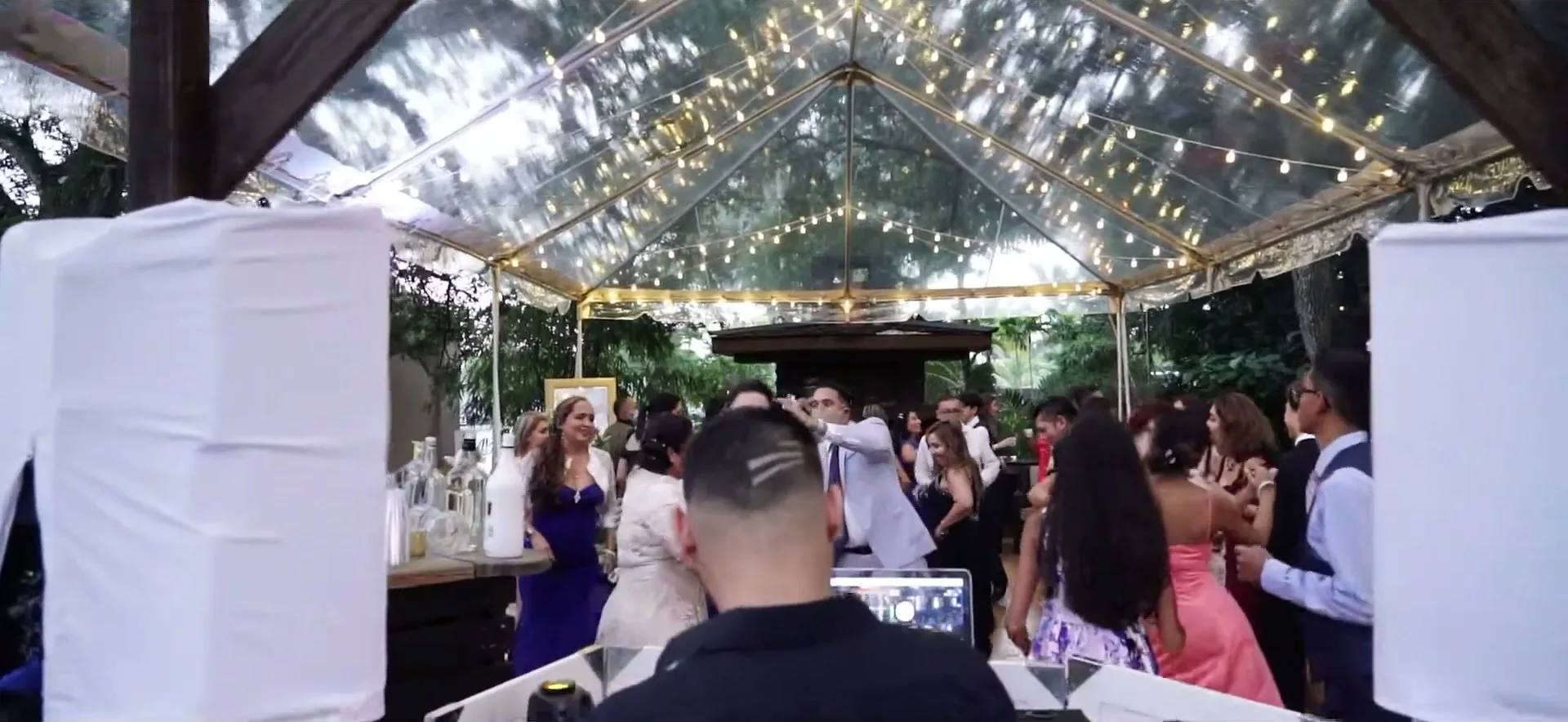
A tent is the opposite. Bistro strands can run in rows the length of the tent, in a grid like the one in the photo at the top of this page, or out from the center pole in a starburst. Uplights stand inside the perimeter between the tent legs and wash the sidewalls, which glow from outside when the walls are down for rain. Every attachment point is the tent company's call, so we ask them for approved hanging points and coordinate before either crew arrives. For draped rooms and ceremony backdrops, our pipe and drape page shows how fabric and uplights work together.
What Changes on Patios, in Gardens and in Backyards?
Outdoors, the trees and the house become your walls, and the strands become your ceiling. That is where the pairing earns its keep.
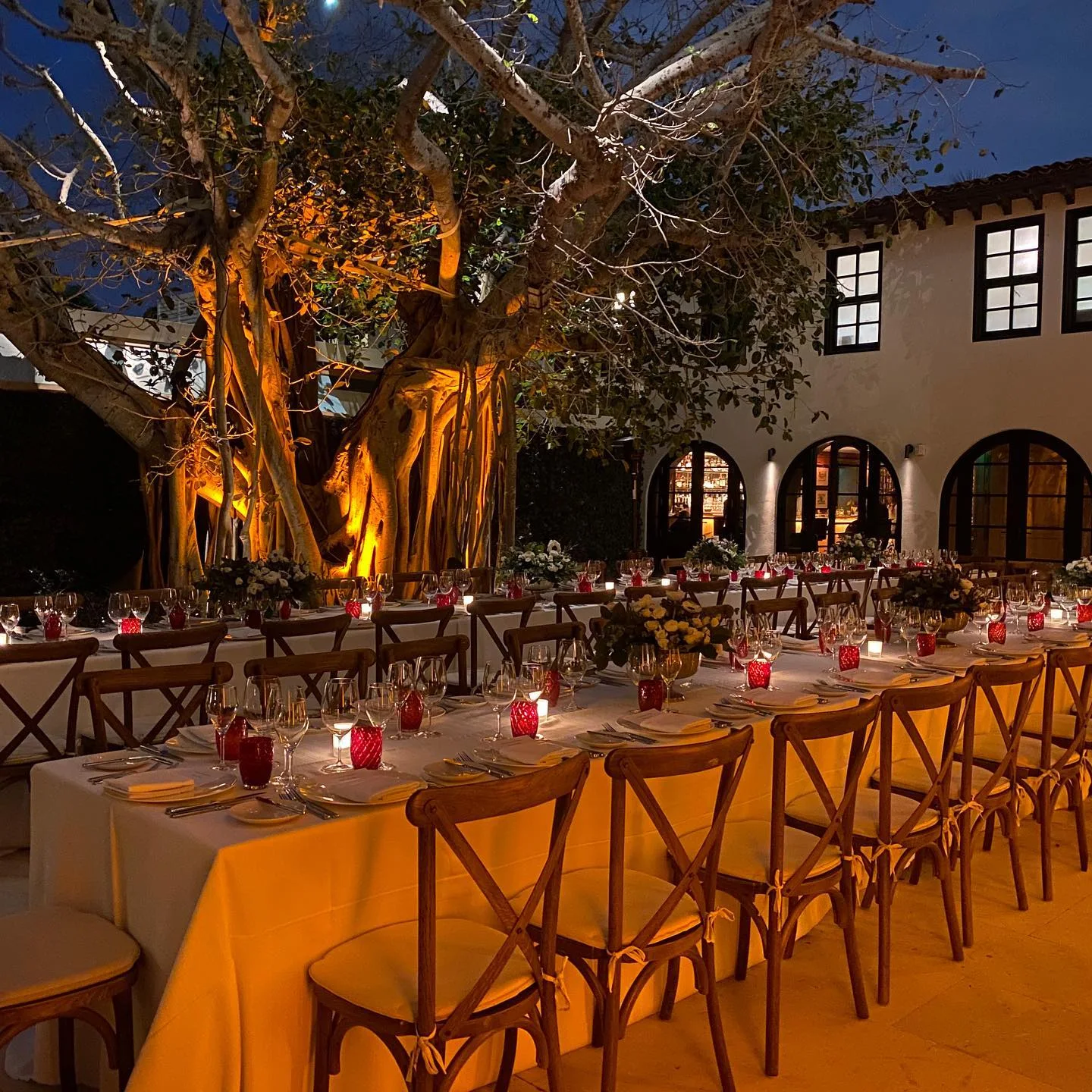
Banyans, royal palms and sea grapes take uplight better than any wall. Aim one or two fixtures at a big trunk and the canopy glows over the tables. On grass, sand and pavers, fixtures need level footing and a clear spot where nobody will kick them; on a pool deck, they stay well back from the water and out of the walking path.
Patios and courtyards are where bistro lights are most at home: the walls of the house give natural anchor points at one end, and a row of poles or a pergola gives the other. Backyard receptions are often the most rewarding jobs we do, because a lawn that looks ordinary at four in the afternoon can look like a restaurant terrace by eight.
Google review
“Eddie and the SoFlo Main Events Team were a pure pleasure to work with. Everyone was very professional, helpful and provided amazing hospitality. Eddie transformed our generic backyard area to a beautiful romantic setting using Bistro Lights and Uplighting. His DJ’ing services were also spot on, listened to what the Client requested and delivered just so. I would definitely recommend SoFlo Main Events! Great Job!”
How Are Bistro Lights Hung at an Outdoor Wedding?
Bistro strands need a solid anchor at every end and every turn, and the strand itself should never carry the weight of a long span. Across the industry, the common methods look like this:
- Tent frames and polesThe cleanest option when there is a tent. Strands attach at points the tent company approves, often along a tensioned cable so the bulbs sag evenly instead of drooping in the middle.
- Light poles with weighted basesThe usual answer for a lawn with no trees. Poles stand at the corners and along the sides, held by heavy bases or ballast, and strands run between them in parallel rows or a zigzag. Stakes go into the ground only after the owner says yes and buried lines are marked.
- TrussFor long spans, a stage area or a dance floor in the middle of a field, a truss frame gives a rigid grid to hang from. It is the same structure we use for staging; see our trussing work.
- Trees, palms and buildingsPossible, with permission. Venues and homeowners have strong opinions about hardware on trees, fascia and railings, and palm trunks move in the wind. We ask before we plan around them.
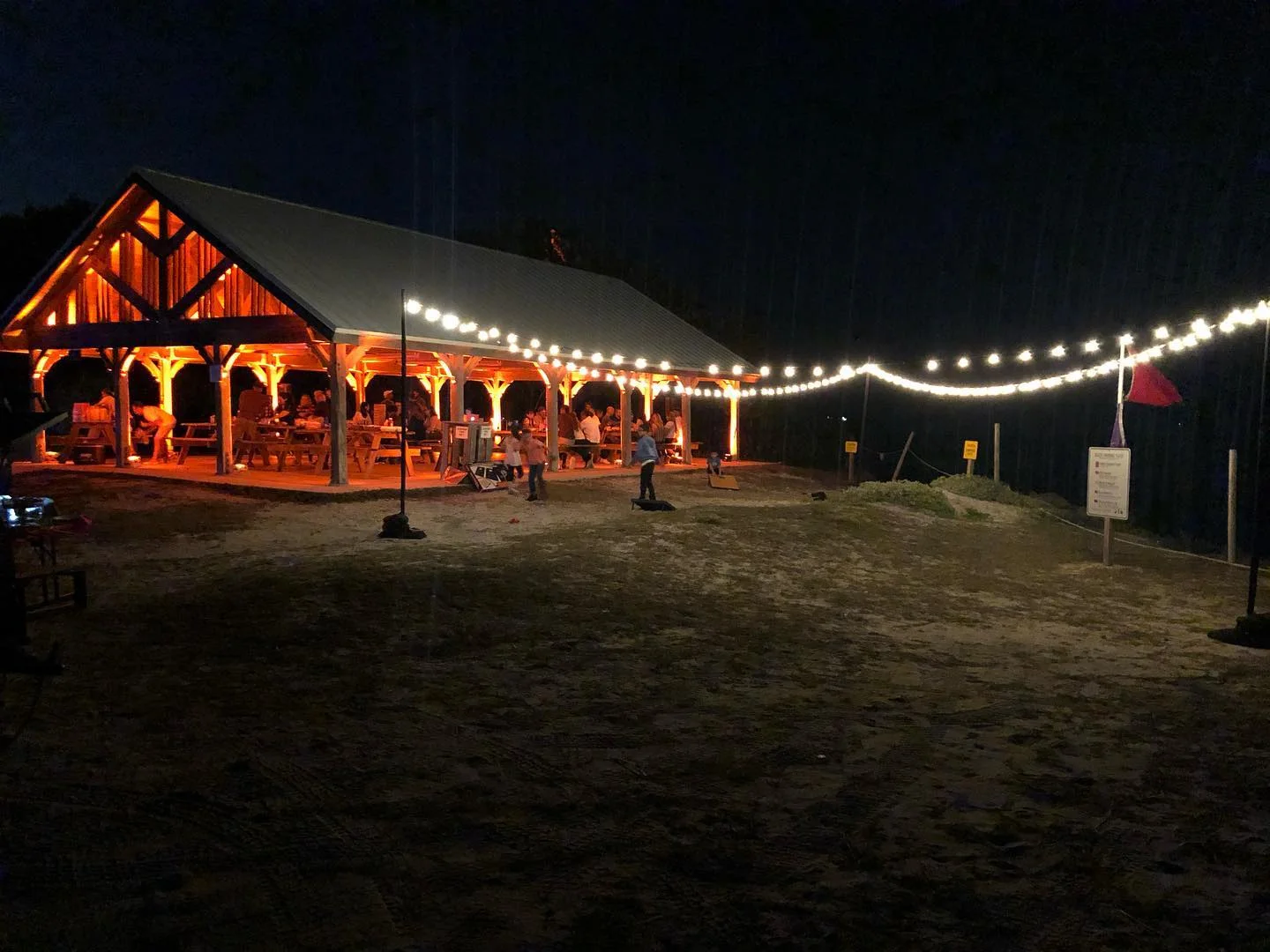
Grid, rows or zigzag is a taste question with one practical rule: the dance floor and the main tables need the densest coverage, and walkways need enough light that nobody misses a step. Bistro bulbs are mood light and do not replace the lighting a venue keeps on its paths and stairs.
What About Power, Battery Fixtures, Rain and Wind?
Power decides more outdoor lighting plans than taste does. Ask where every outlet is, which circuits they share, and who else is plugging in: the caterer, the band, the fans and the bar fridge all draw from the same panel.
Our uplights are wireless, which means no cable running across the lawn to each fixture and far fewer trip hazards. Bistro strands still need a power run, and long runs need planning so cables stay off guest paths and away from wet ground. If the site has no usable power, the conversation turns to a generator, where it sits and how loud it is. Tell us about power early; it shapes the drawing more than anything else.
South Florida weather gets its own line in the plan. Summer storms build fast in the afternoon, wind turns long strands into sails, and lightning stops outdoor work for everyone. Ask any lighting crew what is rated for outdoor use, how strands are anchored against gusts, who decides when to switch off, and where the gear goes when the rain arrives. Hurricane season runs June 1 to November 30, so a rain location and a written weather call belong in every outdoor wedding plan.
What Changes on the Beach During Sea Turtle Season?
On a beachfront property, decorative lights that can be seen from the sand are restricted during nesting season, and that includes uplights on trees and string lights over a terrace. Plan the lighting for a beach wedding around those rules from the start.
As of our last check, the Florida Fish and Wildlife Conservation Commission page on sea turtles and lights names uplights, string lights and lights in trees as decorative lighting that should stay off until nesting season ends on October 31, and sets three rules for any light that stays on: keep it low, keep it long wavelength (amber, orange or red), and keep it shielded from the beach. The City of Fort Lauderdale lists its nesting season as March 1 through October 31 with regular inspections, and Broward County gives the same dates. Other cities set their own rules; FWC keeps a map of local lighting ordinances.
What that means in practice: from March through October, a reception on an oceanfront terrace leans on lighting that faces inland, stays low and stays warm, and color moves indoors or behind the building. Ask your venue for its turtle lighting rules in writing, and expect them to be stricter than anything we would propose.
Where Do You Start With Wedding Uplighting and Bistro Lighting?
Start with three facts: the venue, the time the sun sets on your date, and which parts of the night happen outside. With those we can tell you where uplights belong, whether strands make sense and what the venue will ask of us.
Price follows the plan rather than a package: the number of uplights, the length of bistro strands, what they hang from, how far the power runs, and how long the crew has to set up and strike. Read how it all fits into a full reception on our weddings page, see local notes for uplighting in Miami and uplighting in Fort Lauderdale, or read our guide to audio, lighting and DJ planning for Fort Lauderdale receptions. When you are ready, send us your venue and date.
Quick Answers
Are bistro lights the same as string lights?
Yes. Bistro lights, string lights, cafe lights and market lights all describe strands of round bulbs hung overhead. Fairy lights are different: tiny points on thin wire, used inside drape and greenery.
Is uplighting necessary at a wedding?
Not always. In a room with beautiful architecture and good house lighting, a few warm fixtures may be enough. In a plain ballroom or a dark garden, it is the single change guests notice most.
What uplighting color is most flattering?
Amber and warm white, because they warm skin instead of tinting it. Blush and lavender come next. Keep deep blue, green and red for later in the night or for trees and foliage.
How do you hang string lights in a backyard with no trees?
With poles on weighted bases at the corners and along the sides, or with truss for long spans. Strands run between them in rows or a zigzag, anchored so they hold up in a breeze.
Can uplights work without an outlet?
Ours are wireless, so each fixture can stand where there is no outlet. Bistro strands still need a power run, so tell us where the outlets are or whether a generator is planned.
How much do uplighting and bistro lights cost for a wedding?
It depends on how many uplights, how many feet of strands, what they hang from and how far the power has to go. Send us the venue and date and we will price your actual layout.
Can we do it ourselves?
Plenty of couples hang a few strands at home. A reception is harder: long spans, safe anchors, power for a whole night and a crew to strike it at midnight. That is the part people hire us for.